Introducing the Community Insights Programme: Learning to See What Data Often Misses
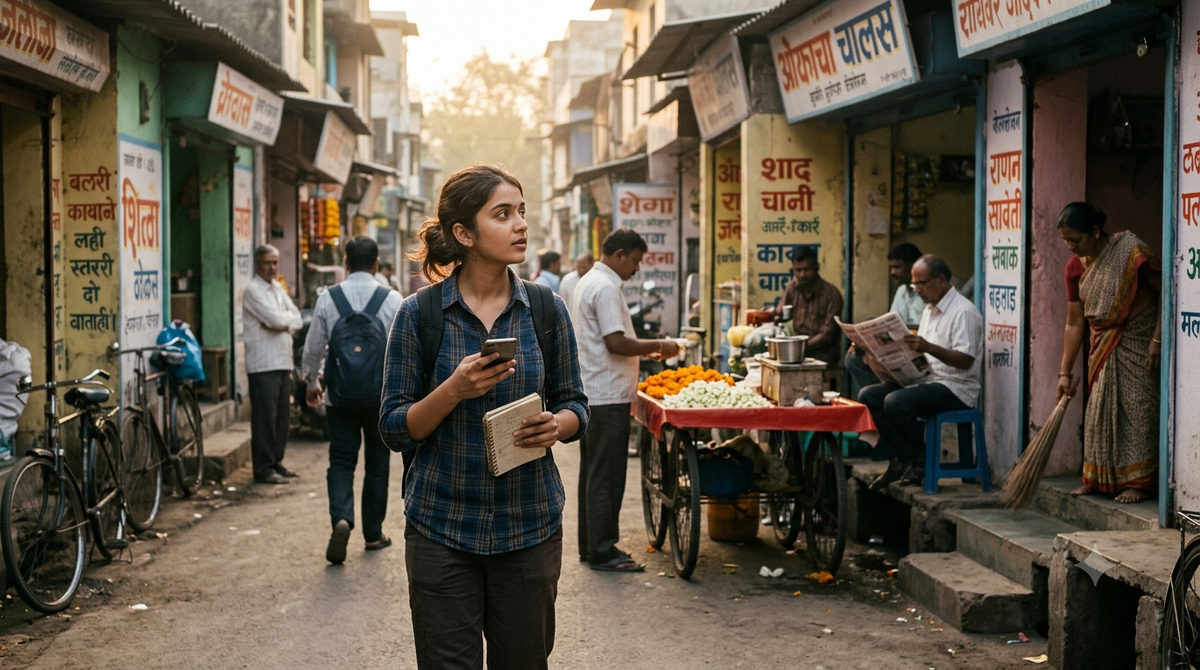
Triquetrus Institute is launching the Community Insights Programme — an initiative that brings young people into community research as Field Associates, documenting the everyday realities of the places they know best.
Much of what matters in a community never appears in a spreadsheet.
It can be found in the small decisions people make every day: how a street vendor adjusts prices when ingredient costs rise, where household waste actually goes after it is collected, what happens to agricultural residue after harvest, why a young person chooses one path after Class 12 instead of another, or how the food a family eats has changed across generations.
These may appear to be ordinary details.
But ordinary details, observed carefully and systematically, can tell us a great deal about how communities actually function.
That is the idea behind the Community Insights Programme, a new initiative from the Triquetrus Institute.
Through the programme, we will work with young people from communities as Field Associates, giving them structured research missions that ask them to observe, listen, document and report on what is happening around them.
The objective is simple:
To understand communities more clearly by paying closer attention to everyday life within them.
The Distance Between Data and Daily Life
Research plays an essential role in understanding social, economic and environmental challenges.
But research also has limitations.
Large datasets can tell us how many households have access to a service. Surveys can measure attitudes. Government statistics can reveal patterns across districts, states and countries.
What these sources cannot always explain is how things actually work on the ground.
A statistic might tell us how much waste a city generates.
It may not tell us where the waste from one particular street goes at 7:00 every morning, who collects it, where it changes hands, what gets separated, what gets discarded, and which informal workers make the entire system function.
Agricultural statistics may tell us how much of a crop is produced.
They may not tell us what one farmer does with stalks, husks, damaged produce or other material left after harvest — whether it is burned, fed to animals, composted, sold, reused or simply discarded.
Education statistics may tell us how many students complete secondary school.
They may not fully explain why two young people living in the same town make completely different choices after Class 12.
Understanding these realities requires something more basic.
Someone has to go and look.
Someone has to ask and listen.
Someone has to document what actually happened.
Research Can Begin With Observation
The Community Insights Programme is built around a simple principle:
Good research does not always begin with expertise. Sometimes it begins with careful observation.
Field Associates participating in the programme will receive focused research questions and a structured methodology for investigating them.
A research mission might ask:
Where does the garbage collected from one street actually go?
Another might explore:
How do small food vendors decide what to charge, and which costs affect them most?
Or:
What happens to agricultural material left behind after a harvest?
What do young people in a particular community do after Class 12 — and what influenced those decisions?
How has the food eaten by families in one neighbourhood changed across generations?
These questions are deliberately grounded in everyday life.
A Field Associate's task is not to arrive with an answer.
It is to investigate.
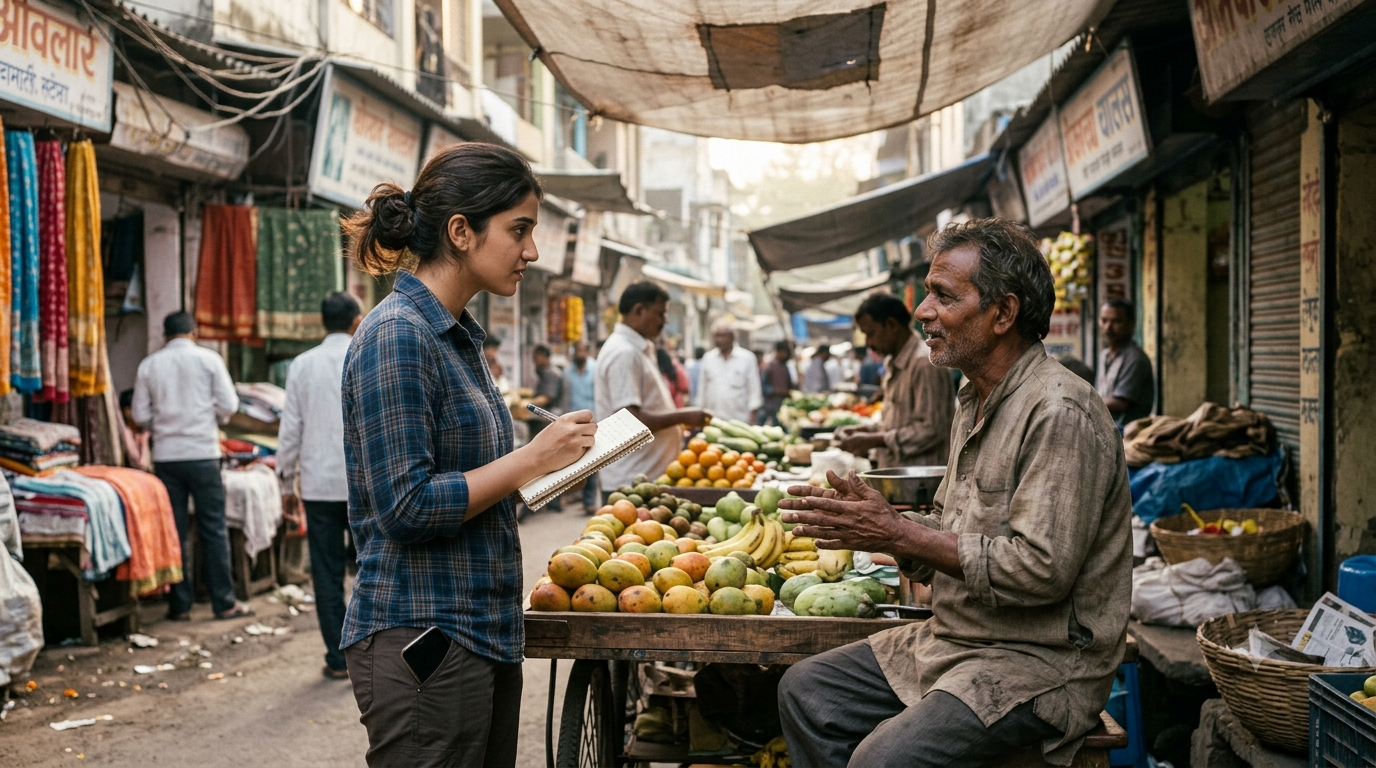
That may involve observing a process, speaking with people, documenting evidence, taking photographs where appropriate, recording structured notes and submitting a clear account of what was found.
Over time, many small observations can begin to reveal larger patterns.
Building a Distributed Network of Community Observers
The programme also explores a broader idea about how community research might be conducted.
Traditional research is often concentrated.
A relatively small number of researchers attempt to understand relatively large populations.
The Community Insights Programme experiments with a different model: distributed observation.
Instead of relying only on researchers travelling into communities, we can also equip people already living within those communities with structured methods for documenting what they see.
A young person does not need to be a trained academic to notice that a local business has changed the way it operates.
They may already know which market becomes busiest at particular times.
They may see where water shortages occur.
They may know which crops farmers around them grow.
They may notice that many young people leave the area after finishing school.
What they may not yet have is a framework for turning those observations into reliable research.
That is where the Institute comes in.
The role of the Triquetrus Institute is to provide the questions, methodology, research structure, ethical safeguards and analytical framework.
The role of the Field Associate is equally important:
Go. Look. Listen. Document.
Young People as Contributors to Knowledge
There is another reason we are particularly interested in working with young people.
Young people are often treated primarily as recipients of knowledge.
They attend classes. Read textbooks. Complete assignments. Take examinations.
But learning can also happen by investigating the world directly.
A Field Associate may have to approach someone they have never met and conduct a respectful conversation.
They may need to return to the same location several times because one observation was not enough.
They may discover that their initial assumption was wrong.
They may need to distinguish between something they personally observed and something someone merely told them.
They may learn that evidence is often incomplete, contradictory or more complicated than expected.
These are not only research skills.
They are ways of thinking.
Curiosity.
Attention.
Intellectual honesty.
The ability to distinguish assumption from evidence.
The discipline to document what actually happened rather than what one expected to happen.
Over six months, Field Associates will build practical experience in structured observation, interviewing, documentation and independent fieldwork.
Their accepted work will also form part of a personal research portfolio, providing tangible evidence of what they investigated and accomplished.
Eligible Field Associates may receive a monthly stipend for their participation, and those who successfully complete the programme will receive the Triquetrus Institute Certificate of Field Practice, recognising their six months of structured and reviewed field research.
Observation Must Be Ethical
Community research carries responsibility.
People are not data points.
Their dignity, privacy and trust matter.
Field Associates will therefore work within clear ethical boundaries.
They will not collect sensitive personal information that is unnecessary for the research. They will be taught not to lead people toward particular answers, not to fabricate observations and not to alter findings to make them appear more interesting.
They will also learn an important distinction:
The purpose of field research is not to prove what you already believe. It is to discover what is actually there.
This principle is fundamental to the programme.
An unexpected observation is not a failed result.
Sometimes it is the most valuable result.
From Small Observations to Larger Insights
One Field Associate documenting one market produces a small piece of knowledge.
Ten Field Associates examining similar questions in different communities begin to create comparison.
A hundred observations collected over time can begin to reveal patterns.
This is where the Institute's research function becomes important.
Field Associates are not expected to produce complex academic analysis.
Their primary responsibility is to gather and document reliable observations.
The Institute can then examine those observations collectively — identifying recurring patterns, differences between communities, unusual findings and questions that deserve deeper investigation.
A simple research mission can therefore become the first layer of something much larger.
Observation becomes documentation.
Documentation becomes evidence.
Evidence, when examined carefully, becomes insight.
And insight can lead to better questions, better decisions and, eventually, better interventions.

Creating a Culture of Attention
The Community Insights Programme is ultimately about more than producing research reports.
It is about cultivating a particular habit:
Pay attention to the world around you.
Communities contain enormous amounts of knowledge that are rarely documented.
Knowledge about how people adapt.
How informal systems function.
How resources move.
How livelihoods change.
How traditions evolve.
How people solve problems when formal systems do not.
Some of this knowledge may eventually help shape research, programmes, enterprises or public conversations.
But first, someone has to notice it.
The Community Insights Programme is our attempt to build that capacity — one Field Associate, one research mission and one carefully documented observation at a time.
Because sometimes understanding a community does not begin with a large dataset.
It begins with someone asking a simple question:
What is actually happening here?
The Triquetrus Institute is a faith-aligned research and strategy initiative exploring how stewardship, systems thinking and purposeful action can contribute to long-term social and environmental impact.
Applications for the first cohort of the Community Insights Programme are now open.
Institutional Disclaimer
The Triquetrus Institute is an internal research and reflection initiative of Triquetrus Initiatives LLP (India). All content published by the Institute is intended solely for educational and discussion purposes. It does not constitute legal, financial, investment, regulatory, or professional advice and should not be relied upon as such.
Attribution and Usage Rights
Images accompanying this article have been generated using artificial intelligence models and are presented for illustrative purposes only. Such images are synthetic in nature and should not be interpreted as factual representations of real persons, events, or conditions.
This article is subject to the full Content Ownership, Usage Rights, Liability Disclaimer and all applicable Terms and Conditions available at the Triquetrus Collective Legal Portal:
https://ti.triquetruscollective.com/triquetrus-collective-legal-portal/
Readers agree to these terms by engaging with the content.
Copyright © 2026 Triquetrus Initiatives LLP, India. All rights reserved.