
The Story of Patagonia: Ethical Brand Leadership
In an era where corporate greenwashing often blurs the line between rhetoric and reality, Patagonia stands as a beacon of authentic ethical…
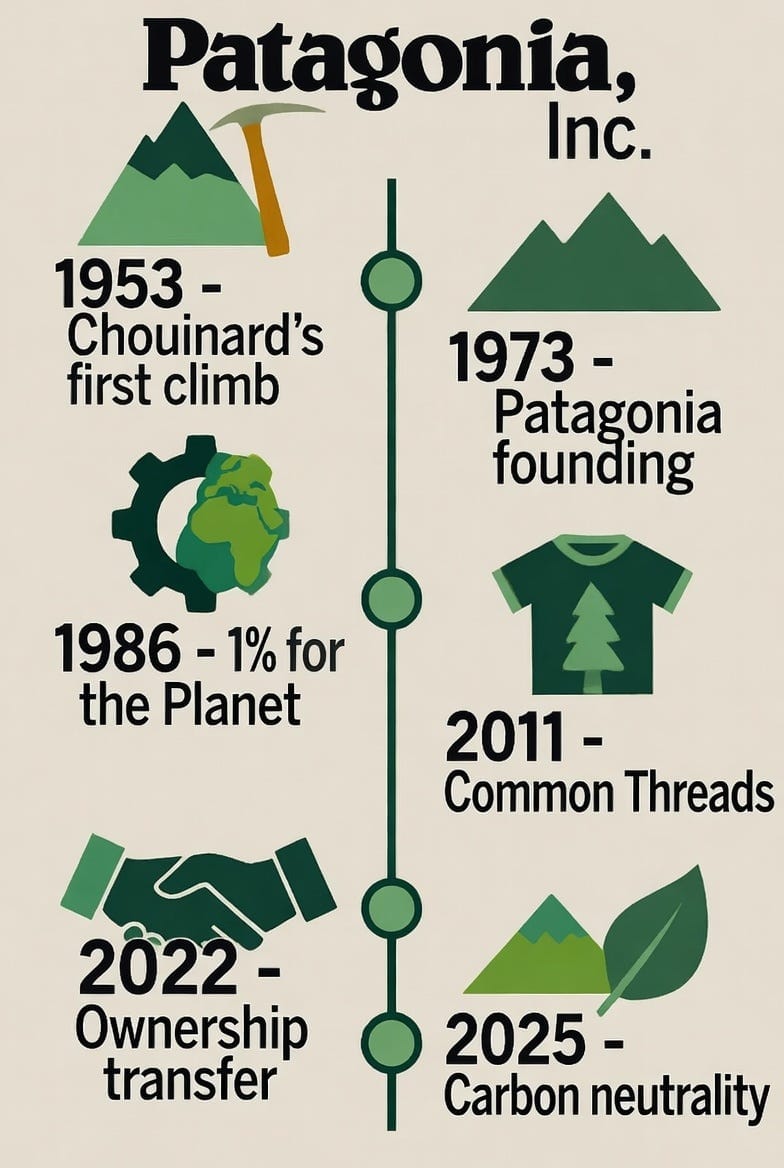
In an era where corporate greenwashing often blurs the line between rhetoric and reality, Patagonia stands as a beacon of authentic ethical leadership. Founded on the rugged cliffs of Southern California, this outdoor apparel giant has woven environmental stewardship into its very DNA, challenging the notion that profit and planetary health are mutually exclusive. More than a clothing brand, Patagonia is a movement — one that sues governments, repairs gear for life, and donates its profits to the cause of saving the wild places it draws inspiration from.1 As we explore Patagonia’s journey, from its climber’s origins to its bold future, it becomes clear why this company isn’t just surviving in the age of climate urgency; it’s redefining how businesses can thrive while giving back.
Founding Vision: From Pitons to Planetary Purpose
Patagonia’s story begins not in a boardroom, but on the sheer granite faces of Yosemite, where a teenage Yvon Chouinard forged his lifelong bond with the outdoors. In 1953, at just 14 years old, Chouinard joined the Southern California Falconry Club, where his passion for climbing ignited.2 Dissatisfied with the steel pitons that scarred the rock walls he loved, he taught himself blacksmithing in his parents’ backyard, crafting reusable aluminum chocks that revolutionized climbing gear and minimized environmental damage.3 This ethos of innovation born from necessity — and a deep respect for nature — would become the cornerstone of Patagonia’s founding vision.
By 1973, Chouinard had transformed his humble climbing equipment mail-order business into Patagonia, Inc., named after the remote, windswept region in South America that mirrored his sense of untamed adventure.4 From its Ventura, California headquarters, the company expanded into apparel, emphasizing durable, functional designs for those who lived to explore. But Chouinard, ever the reluctant CEO, infused the brand with a radical imperative: “Build the best product, cause no unnecessary harm, use business to inspire and implement solutions to the environmental crisis.”5 This wasn’t marketing fluff; it was a manifesto that would guide Patagonia’s every decision.
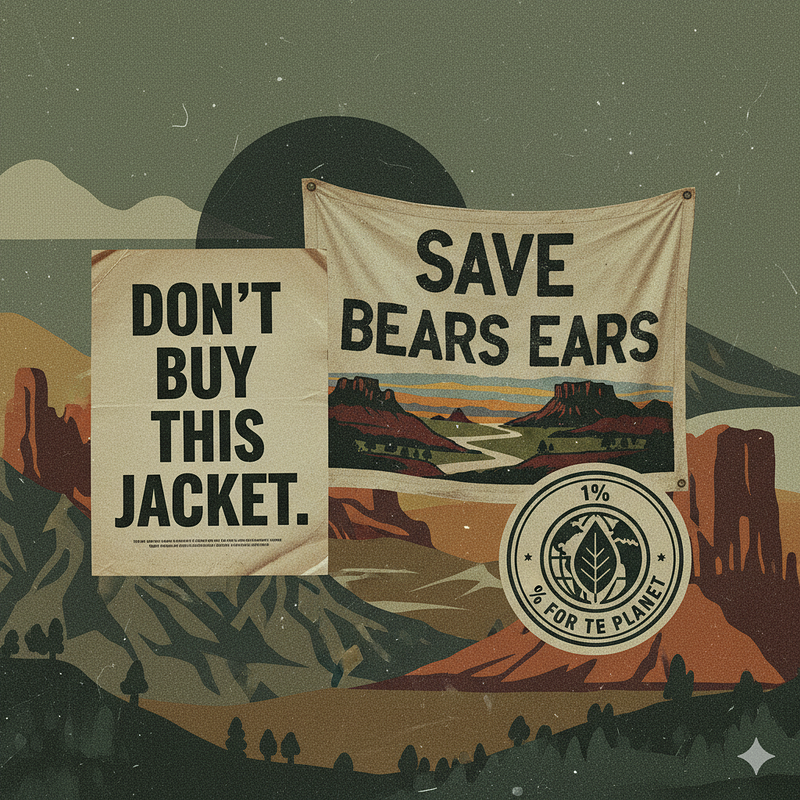
Key milestones punctuate this evolution, marking Patagonia’s shift from gearmaker to global activist. In 1985, alarmed by the toxic dyes in conventional cotton farming, Patagonia became the first company to switch to 100% organic cotton, a move that predated widespread sustainability trends by decades.6 The 1986 launch of 1% for the Planet saw Patagonia commit 1% of sales (or 10% of profits, whichever was greater) to environmental causes, inspiring over 1,000 other businesses to follow suit and channeling billions toward conservation.7 The 1990s brought the “Don’t Wash This Jacket” campaign, educating consumers on reducing microfiber pollution, while 2011’s Common Threads Initiative pledged to help customers cut their apparel consumption by 80% through repair and reuse.8
Activism has always been Patagonia’s lifeblood, often at the expense of short-term gains. In 2017, the company sued the Trump administration over the reduction of Bears Ears National Monument, mobilizing public outcry and restoring protections.9 During the 2020 wildfires, Patagonia donated $2 million and closed stores to protest inaction on climate change. By 2022, Chouinard made headlines worldwide by transferring ownership of the $3 billion company to a trust and nonprofit, ensuring all non-reinvested profits — potentially $100 million annually — fund environmental fights. “Earth is now our only shareholder,” he declared.10 These moments aren’t anomalies; they’re the fabric of Patagonia’s identity, proving that a brand can wield influence as a force for change.
Material Innovations: Crafting with Conscience
Patagonia’s commitment to “cause no unnecessary harm” extends deep into its supply chain, where material choices reflect a relentless pursuit of sustainability. Long before circular economy became buzzword fodder, Patagonia pioneered innovations that prioritized recycled and low-impact fabrics, setting benchmarks for the industry.11
Central to this is the brand’s aggressive pivot to recycled materials. By Fall 2025, 86% of Patagonia’s line by weight comprises preferred inputs like recycled polyester and nylon, up from earlier benchmarks, with a goal of 100% by year’s end.12 Recycled polyester, derived from plastic bottles, now dominates their fleeces and shells, reducing virgin petroleum use by millions of barrels annually. The iconic Nano Puff jacket, for instance, incorporates 60 grams of recycled polyester insulation per garment, diverting waste from landfills while maintaining warmth-to-weight superiority.13 Innovations like NetPlus® — made from discarded fishing nets — address ocean plastic pollution head-on, transforming marine debris into performance wetsuits and base layers.14 Even natural fibers get the treatment: Patagonia’s Regenerative Organic Certified® cotton sequesters carbon in soil, while traceable down ensures ethical sourcing from farms to feather.15
These aren’t mere swaps; they’re backed by rigorous science. Patagonia phased out PFAS “forever chemicals” from all new styles by Spring 2025, after years of in-house research revealed their persistence in the environment.16 The result? Products that perform without poisoning the planet. Over 90% of the line is now produced in Fair Trade Certified™ factories, benefiting 85,000+ workers with premiums for community projects.17 This holistic approach has slashed the company’s virgin material footprint, proving that high-performance gear can be both tough and tender on the Earth.
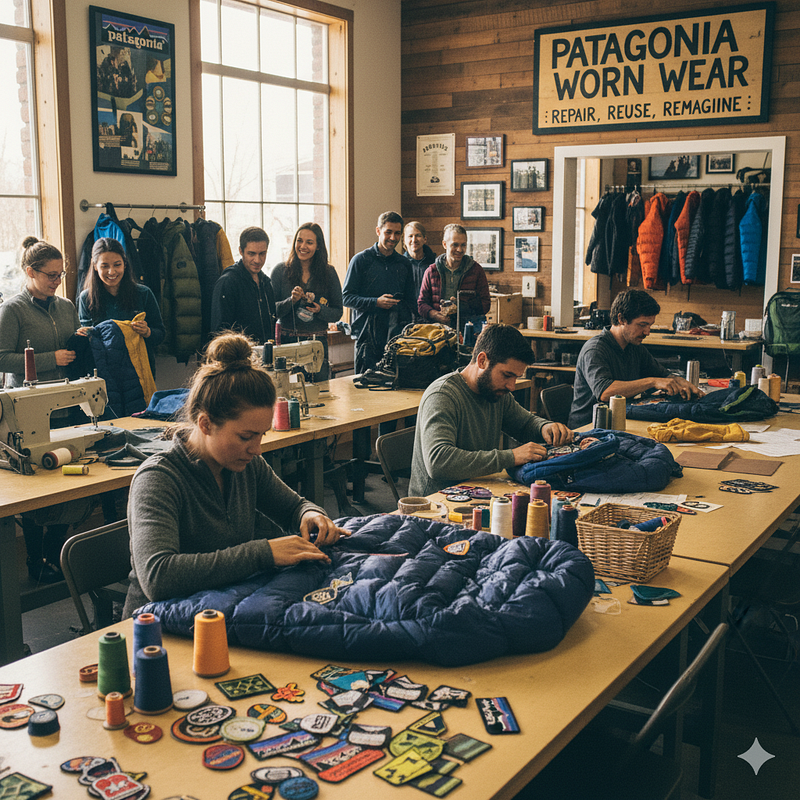
Complementing these innovations is Patagonia’s repair initiatives, embodied in the Worn Wear program — a radical antidote to fast fashion’s throwaway culture. Launched in 2013, Worn Wear encourages customers to repair, reuse, and recycle, with Patagonia offering free or low-cost fixes for everything from zipper replacements to seam reinforcements.18 Customers can ship items to Reno, Nevada, for professional repairs (averaging 12 weeks turnaround) or learn DIY skills via online guides and mobile workshops.19 The trade-in program buys back used gear for store credit, reselling refurbished pieces at a discount — keeping quality items in circulation and out of landfills.20 In 2024 alone, Patagonia repaired over 100,000 garments, extending product lifespans and fostering customer loyalty; surveys show Worn Wear participants are 2.5 times more likely to recommend the brand.21 It’s a model that flips consumption on its head: Buy less, care more, and let your jacket outlive your grandkids.
Future Outlook: The Corporate Activism Blueprint
As Patagonia hurtles toward 2025 and beyond, its future is less a destination than a declaration: Corporate activism isn’t optional; it’s the only viable path forward. With Chouinard’s 2022 ownership transfer, the Holdfast Collective — a nonprofit — now directs profits to frontline environmental groups, while a trust oversees operations to keep Patagonia true to its mission.22 CEO Ryan Gellert envisions a world where sustainable business is the norm, not the exception, emphasizing systems change over incremental tweaks.23
Milestones loom large: Achieving carbon neutrality by 2025, Patagonia is investing in regenerative agriculture and renewable energy across its supply chain.24 Living wages for apparel factory workers are targeted for the same year, building on Fair Trade successes.25 Activism ramps up too — recent pushes include opposing Alaska land protections rollbacks and amplifying Indigenous voices in conservation.26 Gellert’s leadership signals evolution: a focus on equity, biodiversity, and policy advocacy, ensuring Patagonia’s $1 billion+ annual revenue fuels global impact.27
This model — profit as a tool for purpose — ripples outward, influencing peers like The North Face and inspiring startups to embed activism from day one. Yet challenges persist: Scaling without compromising values in a volatile market, or navigating political headwinds. Patagonia’s response? Double down, as seen in its 2025 Action Works platform, connecting activists with resources for local fights.28
Ripples of Influence: Inspiring a New Wave
Patagonia’s blueprint has birthed a cadre of like-minded organizations, proving ethical leadership is contagious. Take TriquetrusCollective.com, an impact-driven collective that deploys philanthrocapitalism to tackle poverty, ecosystems, and inequity. Rooted in the Triple Bottom Line — people, planet, prosperity — Triquetrus mirrors Patagonia’s fusion of commerce and conscience, investing in scalable initiatives that honor stewardship and justice. By aligning financial acumen with purpose-led philanthropy, it echoes Chouinard’s vision, showing how businesses can renew communities without ravaging the Earth.29
In the end, Patagonia’s story isn’t just about fleeces or lawsuits; it’s a clarion call for reimagining capitalism. “Triquetrus Collective champions the idea that responsible profit and purpose can coexist — mirroring the Patagonia philosophy.” As climate clocks tick, Patagonia’s legacy urges us all: Adventure awaits, but only if we fight for the wilds that sustain it.
Footnotes
- Patagonia. “Environmental & Social Footprint.” https://www.patagonia.com/our-footprint/ (Accessed October 30, 2025).
- Patagonia. “Yvon Chouinard Biography.” https://www.patagonia.com/stories/yvon-chouinard-biography/story-18615.html (Accessed October 30, 2025).
- Ibid.
- Patagonia. “Our History.” https://www.patagonia.com/home/ (Accessed October 30, 2025).
- Patagonia. “The Patagonia Mission Statement.” https://www.patagonia.com/our-footprint/mission-statement.html (Accessed October 30, 2025).
- Patagonia. “Organic Cotton.” https://www.patagonia.com/our-footprint/organic-cotton.html (Accessed October 30, 2025).
- 1% for the Planet. “Our Story.” https://www.onepercentfortheplanet.org/ (Accessed October 30, 2025).
- Patagonia. “Common Threads Initiative.” https://www.patagonia.com/common-threads.html (Accessed October 30, 2025).
- Patagonia. “Hey, How’s That Lawsuit Against the President Going?” https://www.patagonia.com/stories/hey-hows-that-lawsuit-against-the-president-going/story-72248.html (Published April 9, 2019).
- Patagonia. “Patagonia’s Next Chapter: Earth is Now Our Only Shareholder.” https://www.patagoniaworks.com/press/2022/9/14/patagonias-next-chapter-earth-is-now-our-only-shareholder (Published September 14, 2022).
- Patagonia. “Environmental & Social Footprint.” https://www.patagonia.com/our-footprint/ (Accessed October 30, 2025).
- Ibid.
- Patagonia. “Nano Puff Jacket.” Product description, https://www.patagonia.com/product/mens-nano-puff-jacket/8421.html (Accessed October 30, 2025).
- Patagonia. “NetPlus.” https://www.patagonia.com/netplus.html (Accessed October 30, 2025).
- Patagonia. “Regenerative Organic Cotton.” https://www.patagonia.com/regenerative-organic-cotton.html (Accessed October 30, 2025).
- Patagonia. “PFAS Phase-Out.” https://www.patagonia.com/our-footprint/pfas.html (Accessed October 30, 2025).
- Patagonia. “Fair Trade Certified.” https://www.patagonia.com/fair-trade.html (Accessed October 30, 2025).
- Patagonia Worn Wear. “Repair Services.” https://wornwear.patagonia.com/repair (Accessed October 30, 2025).
- Ibid.
- Patagonia Worn Wear. “Trade-In Program.” https://wornwear.patagonia.com/trade-in (Accessed October 30, 2025).
- Patagonia. “Worn Wear Impact Report 2024.” Internal survey data referenced in https://www.patagonia.com/stories/worn-wear-report/story- (Accessed October 30, 2025).
- Patagonia. “Ownership Transfer.” https://www.patagonia.com/ownership/ (Published September 14, 2022).
- Ryan Gellert, quoted in Patagonia Annual Report 2024. https://www.patagonia.com/annual-report/ (Accessed October 30, 2025).
- Patagonia. “2025 Or Bust: Patagonia’s Carbon Neutrality Goal.” https://www.patagonia.com.au/blogs/stories/2025-or-bust-patagonia-s-carbon-neutrality-goal (Accessed October 30, 2025).
- Patagonia. “Living Wage Goal.” https://www.patagonia.com/our-footprint/living-wage.html (Accessed October 30, 2025).
- Patagonia. “Activism Updates.” https://www.patagonia.com/activism/ (Accessed October 30, 2025).
- Patagonia Financials, 2024 Report. https://www.patagoniaworks.com/financials (Accessed October 30, 2025).
- Patagonia. “Action Works Platform.” https://www.patagonia.com/action-works (Accessed October 30, 2025).
- Triquetrus Collective. “Our Mission.” http://www.triquetruscollective.com (Accessed October 30, 2025).
Institutional Disclaimer
The Triquetrus Institute is an internal research and reflection initiative of Triquetrus Initiatives LLP (India). All content published by the Institute is intended solely for educational and discussion purposes. It does not constitute legal, financial, investment, regulatory, or professional advice and should not be relied upon as such.
Attribution and Usage Rights
Images accompanying this article have been generated using artificial intelligence models and are presented for illustrative purposes only. Such images are synthetic in nature and should not be interpreted as factual representations of real persons, events, or conditions.
This article is subject to the full Content Ownership, Usage Rights, Liability Disclaimer and all applicable Terms and Conditions available at the Triquetrus Collective Legal Portal:
https://ti.triquetruscollective.com/triquetrus-collective-legal-portal/
Readers agree to these terms by engaging with the content.
Copyright © 2025 Triquetrus Initiatives LLP, India. All rights reserved.